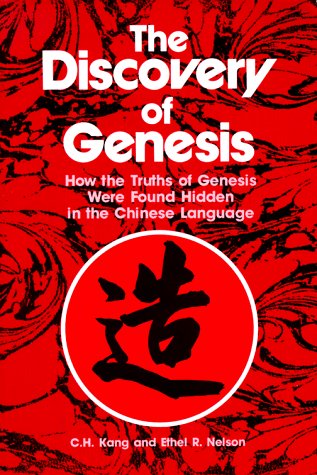
Here's a unique book. C H Kang and (Dr) Ethel Nelson examine the oldest Chinese ideograms and find corrolations with the Genesis account of man's beginnings. Here is the basic timeline at the beginning of Genesis:
Creation
Man and Woman in the Garden of Eden
Deceived by a serpent and cast out of the garden
Man and Woman in the Garden of Eden
Deceived by a serpent and cast out of the garden
The wickedness of man and Noah's flood
The Tower of Babel and the Dispersion of man accross the world
"The Discovery of Genesis" uncovers how these stories formed the ideograms of the more abstract concepts in the Chinese writing system. For instance, "boat" depicts the symbols for "vessel" and "eight" and "persons" combined (confer, eight people on the ark). The first collection and study on Chinese etymology was around 400 BC, when Taoism was the leading philosophy. The words were inevitably interpreted with Taoist meanings, but they existed over a millenium before Taoism came about. Its fun if you like etymology and unfamiliar history.
Evidently, China used to be a monotheistic nation before the introduction of Taoism in the 7th Century (i think?) BC. They worshiped a god named Shang-Ti (or ShangDi, meaning "Emporer of Heaven"). One thing I find particularly interesting is that one of the ideograms of Shang-Ti depicts Him with three mouths, implying three persons. From about 2200 BC to 1911 AD, with a few interruptions, the Chinese performed annual Border Sacrifices to Shang-Ti.
Anyhow, the book is quite interesting and convincing - if you don't have a skeptical inclination to every new idea you hear. Dr Nelson later released a second book entitled "Genesis and the Mystery Confucious Couldn't Solve". I've read most of this one. Though it does spend a good amount of time on etymology, its main focus is on the Border Sacrifices, and the prayers in the ceremonies (these sacrifices being the mystery that Confucious didn't understand). I believe she has released at least one more book in the series.
Check it out. Tell me what you think.


 Posts
Posts


No comments:
Post a Comment